

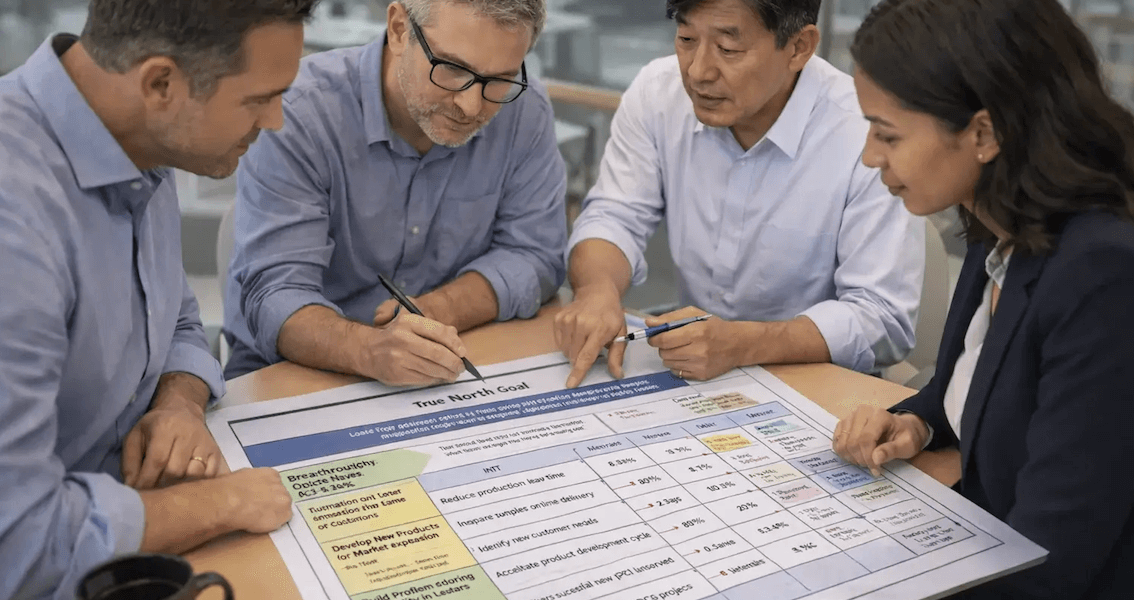
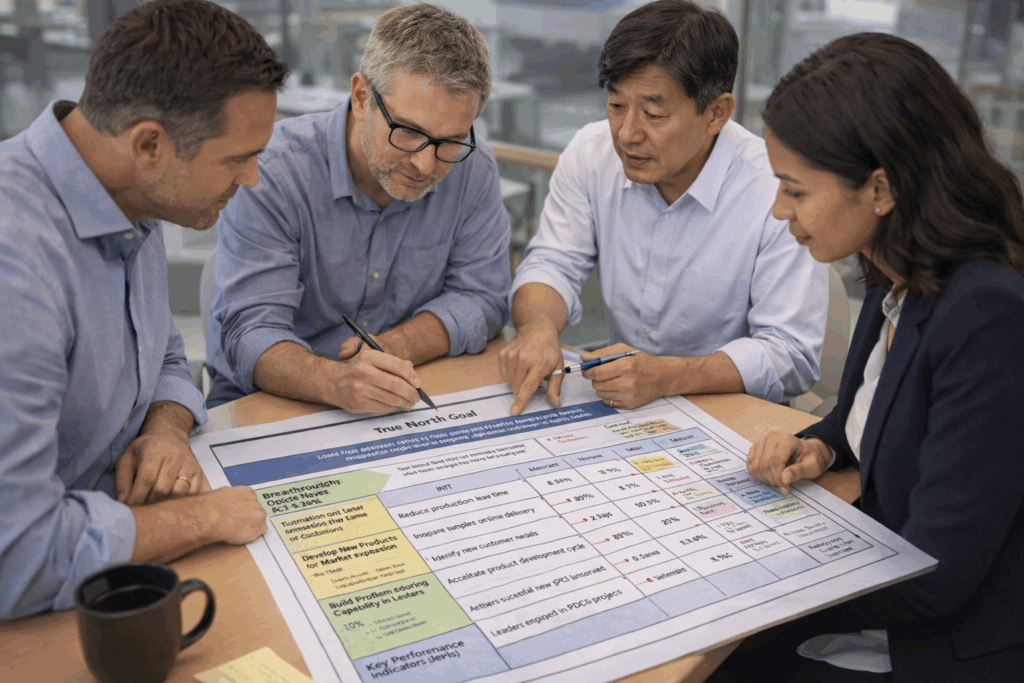
The Hoshin Kanri approach for strategy deployment rarely fails because leaders lack intent, effort, or commitment.
More often, it fails quietly through misalignment, untested assumptions, and management systems that prioritise delivery over learning. Hoshin Kanri or a Management System for Improvement (the non Japanese term we use) was developed to address this exact challenge.
Hoshin Kanri is not as just a planning tools, or a performance management mechanism, it should be created as a management system for improvement (MS-I) that helps organisations learn their way forward. At its core, it is built around disciplined reflection, dialogue vertically & horizontally across levels in an organisation, and the development of problem-solving capability especially in leaders.
Hoshin Kanri Approach (MS-I) – Key Questions
This blog explores why strategy deployment so often breaks down in practice, and provides the questions that Hoshin Kanri helps leaders ask to avoid those failure modes. Rather than prescribing steps or templates, it focuses on the thinking, behaviours, and routines that turn strategy from a demand placed on the organisation into a shared learning challenge.
Why Strategy Deployment So Often Breaks Down
Most organisations do not struggle to create strategy. They struggle to sustain alignment and learning once strategy meets reality. Common symptoms include:
- Clear objectives, but conflicting priorities
- Detailed plans, but limited ownership
- Regular reviews, but little adjustment
- Strong pressure to deliver, but weak problem-solving
From a lean perspective, these are not execution problems. They are system problems. The Hoshin Kanri approach starts from a fundamentally different assumption:
If strategy deployment fails, the management system failed , not the people. That assumption immediately changes the questions leaders must ask.
Are We Clear on the Problem or Just Setting Objectives?
One of the earliest and most persistent mistakes in strategy deployment is skipping reflection and moving straight to goals.
The Hoshin Kanri approach starts by defining the purpose, problem definition and identifying these problems that prevent the organisation from achieving its value-driven purpose.
Questions leaders should ask include:
- What problem are we actually trying to solve?
- Is this primarily a customer problem, a process problem, or a capability problem?
- Will achieving all our objectives actually solve the underlying problem?
When teams define objectives without a shared understanding of the problem, they quickly treat them as targets to defend rather than challenges to learn from.
Have We Confused Vision, Strategy, and Activity?

Another common failure mode is language confusion. Labelling everything as “strategy,” will result in failure to prioritise anything.
In a well defined Management System for Improvement , clear distinctions are made and understood:
The below table is designed to help people understand the different terms when developing and deploying strategy, but more importantly the real thinking question behind the term!
| Key Question & Term | Key Points | Reason Why Its Important |
| Why do we exist beyond making money? Value Driven Purpose (VDP) | Value starts with the Customer and being clear about what value do you create and for whom. Why do you, or the organisation do the things that you do? For what value creating purpose & to what end? The Value Driven Purpose is the outcome of answering the questions above – the “WHY” YOUR ORGANISATION EXISTS, the deeper reason you exist. It goes beyond profit & reflects your core values & the positive impact you aim to make in the world. Example: “To improve lives through clean, accessible energy.” | It keeps the organisation focused on delivering customer value while achieving its goals, strengthens motivation by clarifying the purpose behind the work, and connects individual actions to the bigger picture, building ownership, pride, and a deeper sense of contribution across all levels. |
| What do we do, for whom, and how? Mission | The mission operationalises the value-driven purpose MISSION is your WHAT your ORGANISATION does and HOW it delivers value. It’s practical and action-oriented. Example: “We design and deliver affordable solar solutions for homes and businesses.“ | A purpose without action has no impact; the Mission turns values into value by clarifying what you do, who you serve, and how you deliver results. It bridges aspiration and execution, guiding decisions, energising teams, and keeping work focused and meaningful. The purpose is the heart and the mission the hands, both are required to move forward with real impact. |
| What are we trying to Achieve in the long term? Vision | A vision clearly defines the organisation’s desired future state by addressing WHAT, WHERE & WHEN. The bases for a creating vision is the VDP. The Vision should be created to describe WHAT the organisation aims to achieve (the future outcome), WHERE it intends to make its impact (the market, community, or strategic position), and WHEN it expects to get there (time horizon, often 3-10+ yrs). It should be bold, inspiring & longterm. Example: “By 2035, we will lead global markets in sustainable transportation, creating mobility solutions that improve lives everywhere.” | Gives the organisation a clear, compelling destination. It inspires people to move beyond today’s challenges and align their efforts toward a shared future. Setting a bold, long-term direction fuels innovation, guides strategy, and keeps improvement purposeful and connected. It identifies the desired future state, what markets to be in, what products/services to deliver, what capabilities to build, and by when. |
| What does Excellence look like? True North In Lean | True North is your Enduring Compass for Excellence in the form of aspirational Ultimate Goals, aligning everyone to a shared ideal through a clear, guiding statement. In lean, it defines excellence in areas like zero defects, one-piece flow, total value-added, respect for people, short lead times & Kaizen Spirit. It’s not a finish line, but a constant direction shaping culture, decisions and daily actions. Hence True North often appears in lean organisations to provide that stimulus. Example: “Every patient receives the right care, at the right time, every time, with no harm, no waste, and no waiting.” | True North defines excellence and aligns everyone to a shared ideal. It guides culture, decisions, and daily actions through a clear, enduring standard that connects lean principles, KPIs, and behaviours across all levels. A True North provide a relentless stimulation for Continuous Improvement and therefore Problem Solving. |
| How will we win and achieve our vision? Strategy | Your how to win, a set of choices and plans that define HOW you’ll achieve your vision including How Much and Who. It includes priorities, resource allocation, and competitive positioning. Strategy should be developed using scientific thinking with clear data, analysis and actions. Example: “Solar Division has 5% Expansion into emerging markets with modular solar kits by Feb 2027.” | Achieving a bold vision takes more than hope, it requires disciplined strategy. Your “how to win” turns aspiration into execution through clear choices, priorities, and smart resource use. Grounded in data and analysis, it makes your plans inspiring, credible, and results-driven. That’s how vision becomes reality. |
| How do we align daily actions to strategy? Management System for Improvement (MS-I) or Hoshin Kanri | MS-I / Hoshin Kanri is a management system for strategy that defines an organisation’s mid-term and long-term direction, its objectives and targets and then builds alignment vertically and horizontally to execute those plans while developing people’s capability throughout the organisation. | Strategy without alignment is just wishful thinking. Hoshin Kanri matters because it turns vision into coordinated action, ensuring that every level of the organisation is working toward the same goals. It connects long-term direction with daily improvement, builds capability & creates a culture where strategy is lived, not just written. |
Using the 5W-2H to avoid confusion over Terms
Value Driven Purpose expresses the deeper reason an organisation exists beyond profit, whilst Mission translates that purpose into practical action – but often overlaps with both VDP and Vision. Vision defines the bold, outward‑facing destination what, where, and when the organisation aims to achieve, whereas True North is the enduring inward compass that sets timeless standards of excellence; the two can appear interchangeable in lean but differ in scope. Strategy provides the disciplined route, choices, and resource allocation that turn Vision into execution, while True North anchors behaviour.
When Mission drifts into aspirational language or Vision starts to resemble Strategy, boundaries blur and clarity is lost. Keeping each concept distinct and ensuring each answers its part of the 5W-2H framework prevents duplication and misalignment, enabling a clear progression from VDP → Mission → Vision → Strategy → True North that strengthens alignment, motivation, and effective execution.
Answering the Fundamental Questions is the Point
The real importance is not in debating whether something should be called Value Driven Purpose, Mission, Vision, Strategy, or True North, but in answering the fundamental questions that create clarity:
- Why do we exist beyond profit?
- What do we do and for whom?
- What are we aiming to achieve long‑term?
- How will we win?
- What does excellence look like?
Because these terms often overlap, for example; Mission with VDP and Vision / Vision with True North / Strategy with Vision, focusing on the 5W2H questions (Why, What, Who, Where, When, How, How Much) prevents duplication, reduces confusion, and ensures each element has a distinct role.
When organisations prioritise the questions rather than the labels, they build a coherent narrative that links inspiration (VDP and Vision), execution (Strategy), and excellence (True North), driving alignment, motivation, and effective daily improvement.
In Hoshin Kanri, it’s clarity that matters most: terminology is secondary.
The questions behind the terms are the real driver to create alignment, support execution, maintain motivation, and enable natural progression from VDP through to True North.
Are We Deploying Alignment or Just Cascading Pressure?
Many organisations describe strategy deployment solely as “cascading objectives”, the Hoshin Kanri approach deliberately expands on this concept. Instead, it relies on catch-ball , structured two-way dialogue across levels and functions to build shared understanding and commitment.
Key questions include:
- What changed in our strategy because of dialogue with teams?
- Where did we adjust objectives based on insight from the work?
- Are people committing to the strategy, or simply complying with it?
Alignment is not agreement. It is shared understanding developed through dialogue and reflection.
Are We Expecting Results Without Developing Capability?

Strategies often fail not because they are wrong, but because the organisation is not yet capable of executing them.
MS-I treats capability development as a strategic outcome, not an optional benefit.
Leaders should ask:
- What new skills and behaviours does this strategy require?
- Who is expected to learn this year, are the leaders included?
- Have we built time, coaching, and routines to support that learning?
If a strategy depends on capabilities the system does not actively develop, failure is predictable.
Are Leaders Acting as Owners or as Judges?
Leadership behaviour plays a decisive role in whether strategy deployment becomes a learning process or a compliance exercise.
When leaders act primarily as judges of results, people learn to manage appearances. When leaders act as owners of the system, people engage in problem-solving.

Important questions include:
- Do leaders spend more time understanding the work or reviewing the numbers?
- When targets are missed, do we ask “why” or “who”?
- Do leaders see themselves as teachers and coaches, or evaluators?
MS-I reframes accountability: leaders are responsible for creating the conditions for success, not simply demanding outcomes.
Are We Managing Through PDCA or Through the Calendar?
Many strategy processes appear disciplined, but leaders drive them more by reporting cycles than by learning.
Hoshin Kanri embeds PDCA (Plan-Do-Check-Act) at multiple levels:
- Daily and weekly through management routines
- Monthly through review and adjustment
- Annually through reflection and hoshin renewal
Leaders should ask:
- How often do we check progress against intent, not just results?
- Where do teams visibly track gaps and learning?
- Do we adjust plans based on evidence, or simply explain variance?
Without regular reflection and adjustment, even well-designed strategies drift away from reality.
Is the Work Visible Enough to Learn From?
Invisible work creates invisible problems. MS-I places strong emphasis on visualising plans, progress, and problems, not for control, but to enable shared learning.
Questions to consider:
- Can anyone understand progress within 10 feet and 10 seconds?
- Do teams surface problems early, or do they hide them until formal reviews?
- Do visuals invite dialogue, or merely signal compliance?
Visibility accelerates learning. Hidden work delays it.
When Strategy Becomes a Demand, Learning Stops
If there is one question that determines whether strategy deployment strengthens or weakens an organisation, it is this:
Are we treating strategy as a demand or as a learning system?
When we treat strategy as a demand, a familiar pattern emerges:
- Objectives are announced rather than explored
- Targets are defended rather than questioned
- Misses are explained rather than understood
- People comply rather than contribute
Energy shifts from problem-solving to self-protection. Bad news travels slowly and learning quietly stops.
The Hoshin Kanri Approach ( MS-I) Exists to Break this Cycle
When strategy is treated as a learning system, something different happens:
- Objectives become hypotheses
- Plans become experiments
- Reviews become reflection points
- Failure becomes information
This is why MS-I emphasises PDCA, management routines, visual plans, and leader behaviour. These are not governance mechanisms, they are learning mechanisms. They keep strategy connected to reality, capability, and people.
Before refining objectives or tightening KPIs, leaders would do well to ask:
What behaviour does our strategy process actually reward , learning or compliance?
Because the moment strategy becomes a demand, learning stops.
And without learning, even the best strategy will fail, not loudly, but quietly, through disengagement, misalignment, and lost capability.

The Hoshin Kanri approach reminds us that the primary work of leaders is not to demand results, but to create the conditions in which people can learn to achieve them.
Hoshin Kanri – Your Suggested Next Steps
If this article resonated, consider the following as practical next steps:
- Reflect on your current strategy deployment approach.
Where does it encourage learning, and where might it unintentionally reward compliance? - Start small.
Apply the Hoshin Kanri approach / MS-I thinking in one team, function, or value stream before scaling. - Use questions as your primary tool.
Begin leadership conversations with the questions in this article rather than new templates. - Strengthen management routines.
Regular reflection, visualisation, and PDCA are often the missing links between intent and execution.
For those wishing to deepen their understanding of Hoshin Kanri LEA resources on Hoshin Kanri, MS-I, and the Lean Transformation Framework, provide a structured pathway to develop both organisational performance and leadership capability.
Further learning on the Hoshin Kanri Approach / Management System – Improvement
At the UK Lean Summit 2026, I will be discussing the development of an Improvement Management System using Hoshin Kanri. The talk builds on Mark Reich’s “Managing on Purpose” book and the learning processes and materials we have developed with partner organisations. Learn more about my sharing session and see the full agenda by clicking the button below.
We also support organisations in coaching and developing their own Management System for Improvement (MS-I). To find out more, please contact us at [email protected].
-
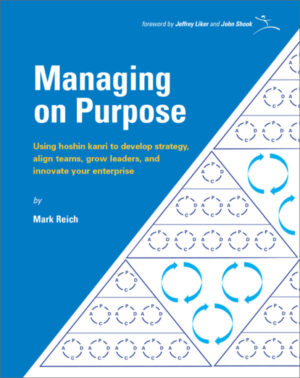
Managing on Purpose
£48.00